The Early Years
On October 1, 1890, Albert Bergte, a bandage maker and orthopedist, opened his bandage workshop not far from Cottbus’s Oberkirche. Three years later, Bergte moved to 10 Dresdener Straße. The new location offered more space for both the workshop and the store, allowing the business to begin offering a wide selection of eyeglasses.
The Roaring Twenties
In 1913, the eyewear business was taken over by his son, Albert Bergte Jr., who was a bandage maker and also an optician. In 1923, following his father’s sudden death, the son continued to run the entire business. Soon, however, the space once again proved too small. Bergte therefore acquired the entire property at Dresdener Straße 3. There, he expanded the optical division and established a department for medical and hospital supplies. In addition, photography supplies and film development services were added to the product line.
During the Third Reich
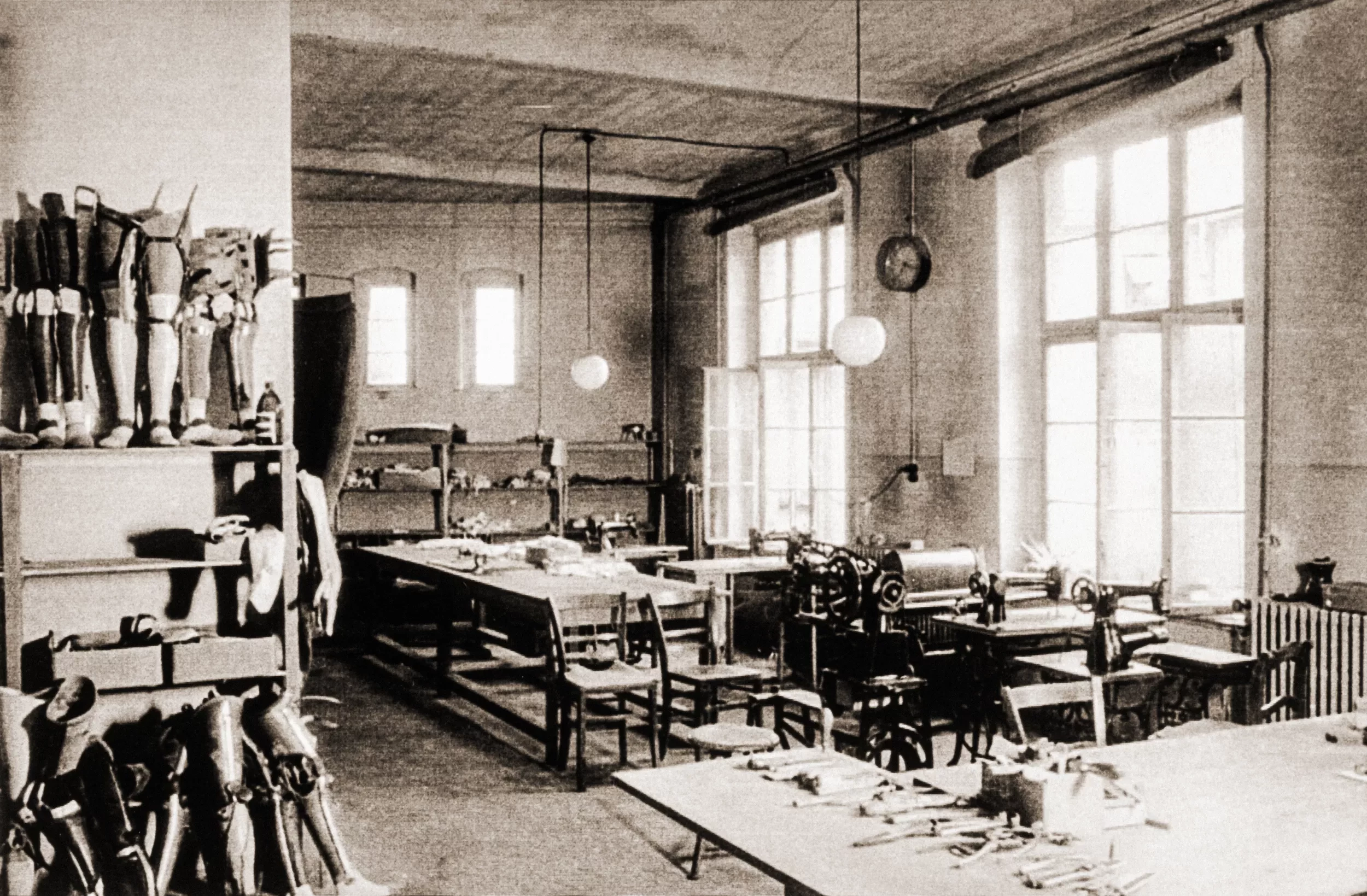
The next step for Zimmermann’s predecessor company was the acquisition of the adjacent property at Ostrower Straße 19. The photo shows the sewing shop and bandage workshop located there. By this time, the Bergte company had also become the region’s largest supplier of hospital and medical supplies. It was not until the partial destruction of the buildings in 1945, during the war, that this upward trend came to a temporary halt.
The Postwar Years
World War II left company owner Albert Bergte Jr. with sales and workshop spaces that were largely destroyed. He managed to make a fresh start at Straße-der-Jugend 2, a former bookstore. Soon afterward, the orthopedic workshops on Ostrower Straße were also able to reopen. After Bergte’s death in 1960, his wife Johanna took over the company and continued to run it successfully. In the years that followed, large parts of what was then the Cottbus district were supplied with orthopedic aids. Bergte’s service area stretched from Cottbus through Klettwitz, Calau, Lauchhammer, and Lübben all the way to Luckau and Senftenberg.
Nationalization
When the last wave of nationalization swept through the GDR in the 1970s and more and more owners decided (more or less voluntarily) to transfer their shares to the state, Johanna Bergte also gave up her stake. The company was placed under the authority of the Cottbus City Council’s Department of Health and Social Services. From then on, it was known as the “State Orthopedic Workshops Cottbus” and was designated the “District Center for Orthopedic Technology.”
The 1970s
In 1976–77, the workshop facilities underwent a comprehensive modernization. Many of the extensive renovation measures were carried out by the employees themselves. In 1977, the workshop area was expanded to include a plastics processing section, where modern materials such as polyester, polyethylene, and polyurethane could be processed. That same year, a training workshop was established on Berliner Straße, where the first apprentices began their training in September 1977.
The 1980s
In 1980, the 35 employees of the Cottbus Orthopedic Workshops served approximately 2,500 patients of all ages. In the years that followed, the service area was expanded: The staff took over patient care in Lübbenau, established a branch office in Finsterwalde, and collaborated with colleagues in Forst.
The range of services was continuously expanded in the 1980s as a result of technical innovations and the introduction of new materials. Examples include non-splinted below-knee prostheses, breast prostheses, care for ostomy patients, and orthotic insoles for children. For the first time, assistive devices worn away from the body were also added to the range of services.
The 1990s
Numerous orthopedic technicians were trained at the Cottbus Orthopedic Workshops. One of them was Jörg Zimmermann.
In the fall of 1989, at the time of the fall of the Berlin Wall, he received his master craftsman’s certificate. Without hesitation, Jörg Zimmermann took advantage of this unexpected freedom to travel and spent a year in Lower Saxony gaining experience in the market economy.
Back in Cottbus, he ushered in a new beginning with privatization in 1991 and founded the Zimmermann Medical Supply Store. This was followed by the purchase and renovation of the front building at Ostrower Straße 19. In October 1993, the medical supply store opened its doors there. Just one year later, the rehabilitation technology division moved into new, modern facilities directly across the street. At the same time, the first branch was established in Senftenberg.
The 2000s
With the goal of investing in a sustainable infrastructure, the company moved into its new corporate building at the end of 1999. The new headquarters on Seegraben brought together a spacious sales area, workshops, storage areas, modern offices, and treatment areas under one roof.
In the 2000s, Zimmermann Medical Supply developed into one of the leading healthcare providers in southern Brandenburg. The company stands for quality, a commitment to innovation, sustainable business practices, and comprehensive care in the fields of orthopedics and orthopedic footwear, rehabilitation technology, and medical and home care supplies.
The 2010s
As the company continued to grow, so did its space requirements. In the early 2010s, the main building on Seegraben was expanded upward. The newly created spaces provided additional room for administration and workshops.
At the same time, the range of services was continuously expanded. Customer service and the vehicle fleet were also steadily expanded.
Planning for a spacious expansion began in 2015. Even then, it was clear that the existing infrastructure would no longer be able to meet the growing demands in the long term. In the future, the various service areas would be distributed across two buildings to create optimal conditions for both patients and the team.
The company’s commitment was honored in 2016 with the Grand Prize for Medium-Sized Businesses—in recognition of entrepreneurial foresight, sustainable development, and social responsibility.